Gilgit-Baltistan Votes, But Who Really Wins? Inside the 2026 Election Verdict
July 31, 2026
|
 مصنف: Islam uddin
|
160 views
مصنف: Islam uddin
|
160 views
مصنف: Islam uddin
|
160 views
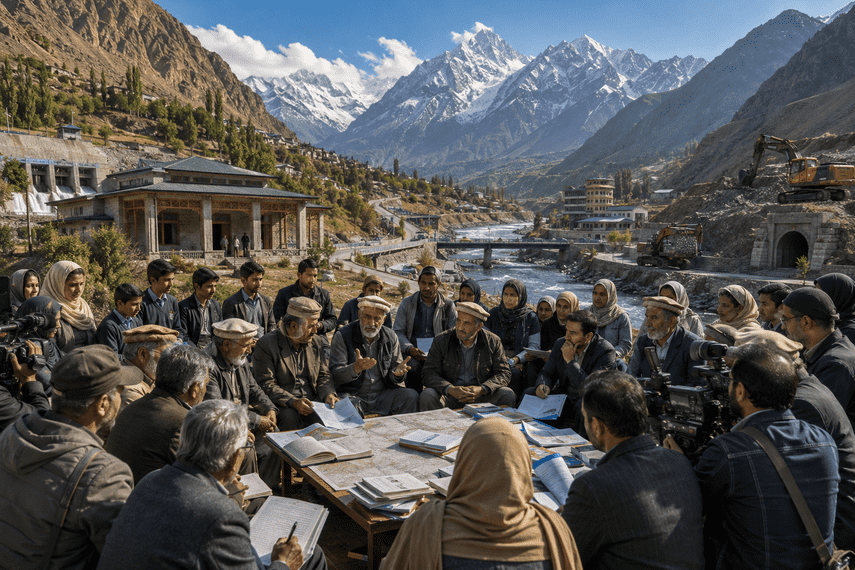
Gilgit-Baltistan, administered by Pakistan, is located in the extreme north of Pakistan, where the world's three great mountain ranges, the Himalayas, the Karakoram and the Hindu Kush, embrace each other. This is the region where the world's second highest peak and the killer mountain Diamrui (Nanga Parbat) is located, and many peaks over eight thousand meters high are located. The Indus River begins its life here.
If you look at the map, this region is in the middle of four countries. China is in the north, India in the east, the Wakhan Strip of Afghanistan in the west, and Kashmir and Khyber Pakhtunkhwa in the south. The area is more than 72 thousand square kilometers and the population is about 2.4 million. Not one language is spoken here, more than seven languages are spoken here, including Sheena, Balti, Broshski, Wakhi, Khowar. Each valley has its own language and its own accent.
In the pages of history, November 1, 1947, is very important for this region, when the people here themselves gained independence from the Dogra Raj. After that, this region came under the administration of Pakistan, but even after seventy-five years, it has not been able to find its place in the constitution. Even today, its name does not even exist in the country's constitution. It has no representative in the National Assembly, nor in the Upper House.
Behind this unconstitutional status is its geographical importance. This is the only region that connects Pakistan with China. The two countries are connected here through the Khunjerab route. A 450-kilometer section of the China-Pakistan Economic Corridor passes through this region. That is why intellectuals from all over the world say that Gwadar has no meaning without Gilgit-Baltistan.
And this importance has become a problem for it. The decision is made elsewhere, the plan is made elsewhere, and the land is used here. Big tourist hotels belong to foreign capitalists, mineral contracts in the mountains belong to foreign companies, and even the lands are under the eyes of people from outside. The local people do not even have secure control over their own land. There is an assembly, which has 33 seats, 24 general seats, six for women and three for experts, but this assembly also does not have real power.
In short, Gilgit-Baltistan is a beautiful, brave and resource-rich region, which is still fighting for its identity, its land and its constitutional rights.
The recent elections were held on June 7, 2026. According to the Election Commission, this time a total of 963,034 voters were registered in ten districts. A total of 403 candidates were in the fray for the 24 general seats, including eight women.
The initial, non-conclusive results were that the PPP emerged as the largest party with 10 seats, while the PML-N won six seats. Two candidates supported by the Tehreek-e-Insaf were successful, while five independents and one candidate from the Majlis-e-Wahdat Muslimeen were elected.
Another report reported the same result, saying that the PPP won ten out of twenty-four seats, the PML-N came in second with six seats, while independent candidates won seven constituencies, two of which were supported by the PTI.
Later, after the decisions on the election objections, the PPP's seats increased to eleven, while the PTI remained at six.
It should be remembered that the situation was completely reversed in the 2020 elections, when the PTI had become the largest party by winning sixteen out of twenty-four general seats, and by adding reserved seats due to being in government at the federal level, it had secured a two-thirds majority.
The PPP established its roots by issuing a decree of autonomy in 2009, the PML-N won votes in the name of roads in 2015, and the PTI fought with the power of the federal government in 2020. The manifesto of all three is the same for Gilgit-Baltistan: make the corridor safe, open minerals and tourism to big capitalists, and call anyone who raises questions a nationalist or traitor.
These parties have never passed a bill to make Gilgit-Baltistan a full province in parliament, because for them, this region is not a vote bank, but a strategic asset.
Five.
In a situation where on one side there is an election campaign worth billions of rupees, helicopter rallies, and an army of federal ministers, and on the other side there is a party like the Awami Workers Party that does not even have money for a banner, getting 3832 votes is not a defeat.
This is proof that 3,832 people have rejected the imported narrative from Punjab and Sindh and have chosen their own local, class-based and anti-colonial narrative. This is a vote that was not based on community, creed, or contract. This is an ideological vote. And ideology is the point in a region where internal colonialism comes out openly.
The PPP is an extension of Sindh, the PML-N of Punjab, and the Tehreek-e-Insaf of the federal government. They do not have their own ideological workers in Gilgit-Baltistan, but before every election, ministers come by shiploads from Islamabad and Lahore, a development package is announced, and local leaders are bought.
3832 votes in Gilgit-Baltistan are not just a number.
In a region where votes are not counted but are determined by arrangement, 3832 votes are actually 3832 consciousnesses. If you look at it from the perspective of Gilgit-Baltistan, what is happening in Gilgit-Baltistan is not classical colonialism, but internal colonialism. Where your name is not even in the constitution, but decisions are made on your mountains, rivers, minerals, and routes elsewhere. Where the state also manages identity, sometimes in the name of sect, sometimes in the name of religion, sometimes wrapped in beautiful words of tourism and development.
In such a situation, doing progressive politics is the most difficult task. Because right-wing politics gets the support of the state machinery, contractors, and community. But progressive
Politics always has to first justify itself that it is not a traitor, not an atheist, not an outside agent. It has to justify its existence first.
So in this land where it is already decided before every election who is going to win, the People's Workers' Party going with its manifesto is actually a victory.
Gramsci used to say that power is not only maintained by guns, but also by the hegemony of narrative. The state convinces people that no other system is possible other than this one. In such a situation, 3832 people saying no, another way is possible, where land, resources and honor belong to the local people, where religion is a private matter and politics is a public service - this is a crack in the hegemony.
Fanon had said that colonialism does not only occupy land, it occupies the mind. So going door to door with a pamphlet, a manifesto, a hope against this mental occupation is a greater act than an election.
These 3832 votes cannot give an assembly seat, but these 3832 questions will not go back. A seed sown in the mountains. And the history of the mountains is a witness that it takes a long time to grow there, but what grows lasts for centuries. In 2015, the Awami Workers Party officially fielded its candidate from Hunza for the first time on behalf of the Left. Similarly, now with the propagation of red flag socialist ideas,
Now, coming out of Hunza, socialist ideas have reached the four constituencies of Gilgit-Baltistan.
In such a situation, we need to move forward by conducting more ideological training and explaining the basis of the class question and the national question in more areas and constituencies.
From Diamer to Kharmang Ganche to Hunza,
From Ghizer to Astore, Gilgit to Nagar-Shigar. Work is needed to formulate a strategy to unite the new generation around this thought.