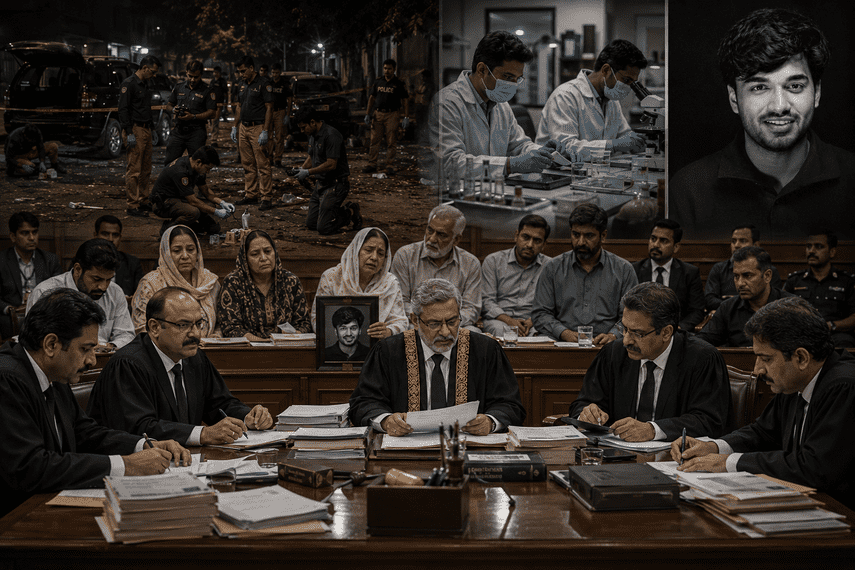
The murder case of young Karachi businessman Mir Raza Ali Khan has taken a significant turn, with the Sindh government deciding to form a judicial commission for a fair and transparent investigation. A formal request will be sent to the Chief Justice of the Sindh High Court to constitute the commission.
According to the spokesperson for the Sindh Chief Minister, the concerns raised by the victim's family have been taken very seriously by the government, and a letter sent by the family to the Chief Minister has already been received. The judicial commission will review any gaps, overlooked aspects, or evidence requiring further investigation in the murder case, and will also examine the conduct of police, medico-legal officers, and other relevant officials.
Also Read: Important development in Mir Raza murder case, presence of gunshot residue on both hands revealed
Under the Sindh Tribunals of Inquiry Ordinance 1969, the commission will hold powers equivalent to a civil court — including summoning witnesses, recording statements under oath, and requisitioning relevant documents and records. Should negligence, dereliction of duty, professional misconduct, or tampering with evidence be established, the commission will also be empowered to recommend action against those responsible. It is required to submit its report, findings, and recommendations within 30 days of its formation, though this timeline can be extended if a thorough and fair investigation demands more time.
The case dates back to the night of July 28, when 25-year-old Mir Raza Ali Khan — a young businessman and IBA graduate — left his home and did not return. His family says his phone was switched off shortly after, prompting a search. The following day, his body was recovered from bushes near Shahi Qila Ground in Gulistan-e-Johar, Block One.
Also Read: Mir Raza murder case, Jibran Nasir makes important demands regarding investigation and evidence
An abduction case was initially registered at Ferozabad police station, but was later upgraded to murder under Section 302 following the postmortem and other evidence. Police say Raza died from a gunshot wound to the chest, resulting in severe blood loss. His mobile phone and a pistol holster were recovered near the scene, and CCTV footage is being reviewed to piece together what happened. Several individuals have since been questioned, and a special investigation team was formed after footage reportedly showed a suspicious motorcycle briefly stopping near where the body was found.
The case took a sharper turn when the Karachi Police Surgeon flagged 14 serious shortcomings in the postmortem report — including the absence of an X-ray, failure to collect hand swabs for gunpowder residue, inadequate forensic documentation of the wounds, and no DNA sample taken for identification.
The family has maintained from the outset that Raza's death was a murder and has repeatedly voiced concerns over how the investigation was handled. Following the widened probe and questions raised over the postmortem process, the Sindh government has now moved to establish a judicial commission to ensure a transparent and impartial inquiry.
The Chief Minister's spokesperson said the Sindh government stands with Mir Raza Ali Khan's family, and that a transparent judicial inquiry will address their legitimate concerns while reinforcing public confidence in the rule of law.
According to the spokesperson for the Sindh Chief Minister, the concerns raised by the victim's family have been taken very seriously by the government, and a letter sent by the family to the Chief Minister has already been received. The judicial commission will review any gaps, overlooked aspects, or evidence requiring further investigation in the murder case, and will also examine the conduct of police, medico-legal officers, and other relevant officials.
Also Read: Important development in Mir Raza murder case, presence of gunshot residue on both hands revealed
Under the Sindh Tribunals of Inquiry Ordinance 1969, the commission will hold powers equivalent to a civil court — including summoning witnesses, recording statements under oath, and requisitioning relevant documents and records. Should negligence, dereliction of duty, professional misconduct, or tampering with evidence be established, the commission will also be empowered to recommend action against those responsible. It is required to submit its report, findings, and recommendations within 30 days of its formation, though this timeline can be extended if a thorough and fair investigation demands more time.
The case dates back to the night of July 28, when 25-year-old Mir Raza Ali Khan — a young businessman and IBA graduate — left his home and did not return. His family says his phone was switched off shortly after, prompting a search. The following day, his body was recovered from bushes near Shahi Qila Ground in Gulistan-e-Johar, Block One.
Also Read: Mir Raza murder case, Jibran Nasir makes important demands regarding investigation and evidence
An abduction case was initially registered at Ferozabad police station, but was later upgraded to murder under Section 302 following the postmortem and other evidence. Police say Raza died from a gunshot wound to the chest, resulting in severe blood loss. His mobile phone and a pistol holster were recovered near the scene, and CCTV footage is being reviewed to piece together what happened. Several individuals have since been questioned, and a special investigation team was formed after footage reportedly showed a suspicious motorcycle briefly stopping near where the body was found.
The case took a sharper turn when the Karachi Police Surgeon flagged 14 serious shortcomings in the postmortem report — including the absence of an X-ray, failure to collect hand swabs for gunpowder residue, inadequate forensic documentation of the wounds, and no DNA sample taken for identification.
The family has maintained from the outset that Raza's death was a murder and has repeatedly voiced concerns over how the investigation was handled. Following the widened probe and questions raised over the postmortem process, the Sindh government has now moved to establish a judicial commission to ensure a transparent and impartial inquiry.
The Chief Minister's spokesperson said the Sindh government stands with Mir Raza Ali Khan's family, and that a transparent judicial inquiry will address their legitimate concerns while reinforcing public confidence in the rule of law.